Articles overview

New e-commerce shop with Shopify or Shopware?

Small and medium-sized enterprises (SMEs) in German-speaking countries in particular often face the question of which e-commerce platform is stable, widely used and quick to implement. Two solutions that are particularly popular choices are Shopify and Shopware. But which solution is the better choice? Both systems offer many similarities and just as many differences. At Dream Production, we actively work with both platforms in client projects and are well acquainted with their respective strengths and weaknesses. In this article, we provide you with a concise decision guide to help you find the right solution for your business model. You will likely have further questions after reading: don’t hesitate to contact us. We’ll be happy to advise you.
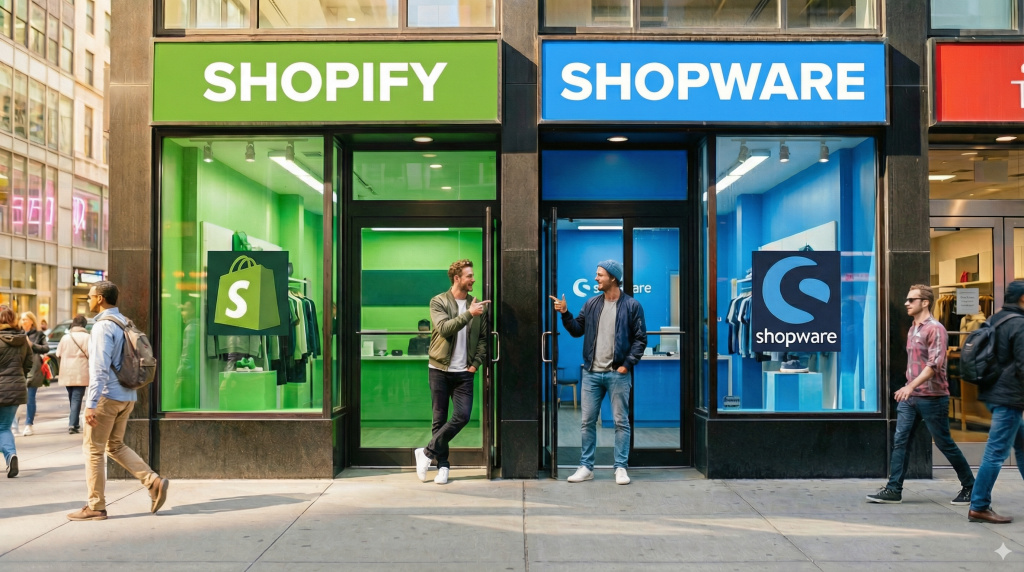
Conclusion: Shopware or Shopify – which solution is better suited? ..

If you need a shop that

  • covers numerous standard functions,
  • is easy to use,
  • does not require technical maintenance,
  • can be put online quickly,

then Shopify is the better choice.

However, if you are looking for a solution that

  • maps complex processes,
  • offers full control over functions and code,

then you should choose Shopware.

Facts & Figures (as of 12.2025)

ShopifyShopware
Country of originCanadaGermany
Data storage
  • Mainly in the USA, also for EU shops

  • Shopify provides contracts and tools to guarantee GDPR compliance

  • with hosting in the EU

  • On-premise (Shopware can be set up on any server)

Offer
  • SaaS (subscription)

  • SaaS - Software as a Service (subscription)

  • PaaS - Platform as a Service

  • Self-Hosted

Prices for SaaS
  • from USD 25 / month
  • from EUR 600 / month, depending on turnover
Active shops worldwide
  • Over 5.6 million online shops
  • More than 175 countries

  • over 100,000 online shops

  • more than 15 countries, mainly in Europe and to a lesser extent in the USA

  • market leader in Germany (2022, 2023, 2024)

Sales volume in 2023
  • USD 5.62 trillion
  • USD 88 billion
Number of plugins
  • 16,000 apps
  • 3,500 extensions
Security updates
  • Shopify automatically takes care of updates, security patches and new features.
  • No manual maintenance or version upgrades are necessary
  • Security updates must be installed regularly (except for SaaS)
Number of days to implement a simple shop (with standard template)
  • 3 - 5 days
  • 2 - 4 weeks
Point-of-sale (POS, external sales points/cash register system)
  • Integrated into standard solution
  • Can be solved with third-party extensions

Opinion & Experience

ShopifyShopware
Administrator console
  • Simple, modern and intuitive design
  • Simple and modern, slightly more technical
Rights & role management
  • Only flexible with Shopify Plus
  • Granularly adjustable
Customisability Theme/Layout
  • Good customisation options via theme customisation using Liquid and CSS
  • The layout can be easily customised with little to moderate programming knowledge
  • Theme customisation using Twig and CSS
  • Full flexibility is available
Code customisability
  • The customisation options in the code are limited because Shopify has a closed-platform structure.
  • Thanks to numerous apps, code customisation can be avoided
  • Good customisation options thanks to open-source structure
Navigation structure
  • Flexibility available, but less pronounced than with Shopware
  • Filters are used to create ‘collections’ that are linked in a menu tree
  • Full flexibility available
  • Products are assigned directly to categories that are already in a menu structure
Check-out
  • Limited customisation options in the basic subscription (e.g. additional fields such as title cannot be easily added)
  • Good customisation options thanks to open source structure
Product types
  • All standard functions are available and can be accessed quickly
  • Extensions with special requirements are limited
  • Product structure and filters can be set up more flexibly than with Shopify
Blog / Landing pages
  • Simple blog function is included in the basic package
  • Landing pages can be created with the page builder or apps
  • No native blog available
  • Highly effective landing pages can be created using the ‘Experience Worlds’ function
  • Good opportunities for content marketing (campaigns, SEO landing pages)
Multilingualism
  • Options available
  • Easy to maintain
  • Options available
  • Due to navigation in the backend, switching languages can cause longer loading times, making it difficult to enter multiple languages
Warehouse management
  • Integrated, easy to use
  • Multiple storage locations possible
  • Integrated, easy to use, but less intuitive
  • Multiple storage locations possible
  • Can be more easily adapted to specific needs
Payment partners / payment gateway
  • Shopify has its own payment gateway, which is easy to activate
  • Many existing payment providers are available
  • Own payment gateways cannot be integrated
  • Many existing payment providers are available
  • Your own payment gateways can be added
Analysis / Statistics
  • Standard reports available
  • Export via CSV, Excel, API possible
  • Scope of reports depends on subscription type
  • Standard reports available
  • Export via CSV, Excel, API possible
  • Reports are somewhat more limited than in Shopify and can be added via additional tools
Marketing
  • Email marketing: Already integrated for newsletters and promotional emails
  • Social media integration: Can be easily integrated
  • Discounts and vouchers: Numerous options available
  • Google Ads and Facebook Ads: Integration with Google Ads and Facebook Ads available.
  • Email marketing: Already integrated for newsletters and promotional emails
  • Social media integration: Can be easily integrated
  • Discounts and vouchers: Numerous options available, vouchers can be created with numerous conditions thanks to the integrated Rule Builder
  • Google Ads and Facebook Ads: Integration with Google Ads and Facebook Ads available.
Speed (Web Core Vitals)
  • Very good baseline values, as long as a lean theme is used and few external apps are utilised
  • Excellent Core Web Vitals, provided active performance tuning is carried out and good hosting is available
SEO
  • Depends on the theme
  • Good, out-of-the-box settings are already implemented; technical knowledge is not required
  • Depends on the theme
  • Fully customisable
  • Addition of plug-ins is recommended
Interfaces to ERP systems
  • A well-documented API is available and works reliably. Functions outside the available API are difficult to implement.
  • Full flexibility is available, but good technical knowledge is required.